


There are several situations where one would like to record a conversation in secret, whether in person or on the phone. Maybe you are receiving threats from your neighbor and want to be the evidence to file a complaint with the police. Maybe you are a victim of workplace harassment by your employer who denies these allegations. Or maybe you’re overhearing a rather funny conversation on public transport and feel like sharing it with your friends.
Is it legal to record a conversation without the knowledge of the interlocutor? Do we have to disclose to the other party the fact that we are recording it?
In this article we explain in which cases you can legally record a private conversation and in which cases you should not.
The right to privacy
First of all, what does the law provide for about recording a conversation?
At the civil level, the Civil Code of Québec lists certain situations that can be considered as invasions of a person’s privacy:
- Enter her home or take anything from her;
- Intercept or intentionally use a private communication;
- Capture or use their image or voice when in private places;
- Monitor their privacy by any means whatsoever;
- Use their name, likeness, likeness or voice for any purpose other than legitimate public information;
- Use correspondence, manuscripts or other personal documents.
At the criminal level, there is an invasion of privacy when a private communication is intercepted. Private communication means:
an oral or telecommunications communication the author of which is in Canada, or intended by the author to a person in Canada, and which is made in such circumstances that the author can reasonably expect not to be intercepted by a third party.
The Criminal Code provides for a prison sentence of up to 5 years for this type of crime.
The private nature of the communication
It is therefore prohibited under the law to record a private communication, i.e. when you are not part of the communication.
So the overarching question to ask is: Are we part of the conversation at hand? Let’s look at this explanatory diagram:
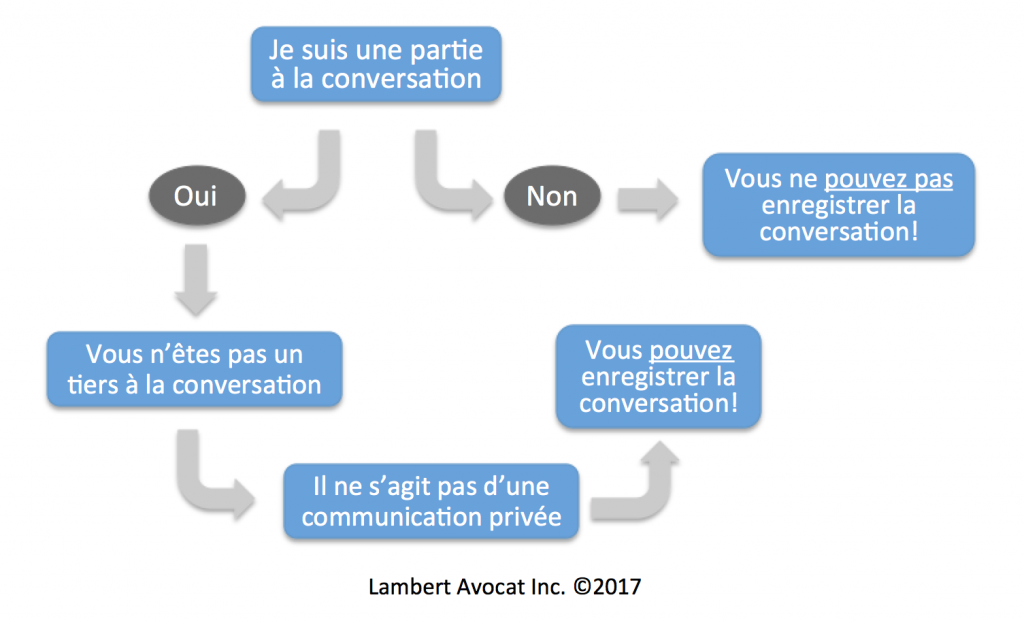
So if a person is a party to a conversation, they are no longer a third of the conversation. If the person is no longer a third party to the conversation, it is not a private communication. In short, if it is not a question of private communication, the person can register his interlocutor without having to mention him, as long as the recording does not constitute an intrusion into his private life.
Waiver of the confidentiality of the conversation
Although it is forbidden to record a private communication, there is an exception. This is the case where the person renounces the private nature of the conversation through his behavior.
Let’s take the case of a person who speaks very loudly in a restaurant and is filmed without his knowledge. In the event of a prosecution, the person who filmed could have a defense that the communication was no longer private because it took place in a public place.
Proof of registration in court
The registration is very good evidence in court and the other party never has to be informed that you are recording it without their consent.
We frequently use this method in medical error cases when a physician claims to have committed a fault.
Similarly, this method is often used in disputes between tenants and landlords. In a judgment of the Régie du logement in which our firm was successful, the judge confirmed the authenticity and integrity of the audio recordings taken without the landlord’s knowledge that revealed the intimidation experienced by our client.
Nowadays, it’s easy to record both on the phone and in person through phone apps. We strongly advise you to record your conversation when you take out a contract with a service company, including an insurance company. Also be careful when making a verbal contract. There are many contexts where recording can be useful to you.