


When we talk about the obligation to clear snow and ice, we often think of sidewalks, steps and the entrance to the building. However, the duty to properly maintain your roof in winter is just as important. Negligence in this regard can have very serious consequences for third parties.
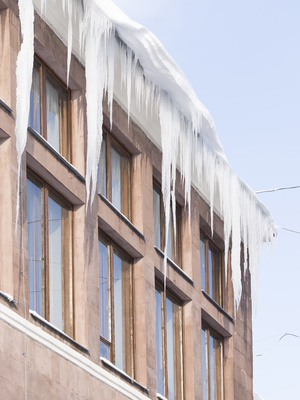
You walk down the street and see a sign that reads: “Be careful, ice fall!” You keep walking, without really taking precautions, and a block of ice falls on you, causing a head injury.
Is the danger notice on the sign sufficient to release the owner of the building from civil liability, or can you sue him? Me Lambert gives you an overview of your obligations and those of the owner, and explains how to act if you want to file a civil liability lawsuit.
Elements of civil liability
To be entitled to legal action, you must prove fault and harm, and establish a causal link between the two.
Under article 1457 of the Civil Code of Québec, everyone has a duty to behave in accordance with certain rules of conduct and without causing harm to others. If a person fails in this duty and this failure causes harm to someone, he will have to repair it.
The fault
You must show that the owner of the building was at fault, that is, that he did not comply with a law or a standard, or that he acted recklessly or negligently.
In making this determination, the Court will look above all at whether he was negligent with regard to the removal of snow from his roof, but may also take into account whether he had, for example, established a safety parameter or whether he had put up a clear and visible sign warning you of the danger.
Harm
Then, the wrongful act (or omission) on the part of the owner must have caused you harm, which may be material, bodily or moral.
For example, if a block of ice falls on you and breaks your foot, you can claim compensation for medical expenses, your difficulty getting around and other inconveniences.
If you need to stand or walk to do your job and therefore have to stop working, you may also be entitled to compensation for lost wages.
Causation
You will have to prove that the fault committed by the owner is the direct cause of the damage you have suffered. This link will often be established by a medical expert.
Often, the owner will try to absolve himself of his responsibility by demonstrating recklessness on your part. He will say, for example, that he had put up a poster alerting you to a potential danger and that you ignored it.
On the other hand, the mere presence of a notice is not sufficient to limit the liability arising from the fault of the owner, according to the law.
However, the notice may constitute a denunciation of danger. This means that you were aware of the potential danger and had to take precautions to avoid being injured, for example, by making sure that there was no imminent danger of an ice cube fall before walking along the building.
In addition, the law provides that even if you have accepted the risk of walking along the building, the owner is not exempt from any liability to you.
In these cases, the Court may find that there has been a division of responsibility between you and the owner, and that the owner will have to pay a percentage of the compensation, which may vary depending on the case.
Let us take the example of a true case, in which the plaintiff parked his car near a defendant’s building, despite the existence of posters with the following text: “Danger – Falling ice”. A snowfall falls on the plaintiff’s car, causing damage. In analyzing the evidence, the Court concludes that the defendant was negligent in the maintenance of its roof, but takes the danger notice into account, ruling that they should share responsibility, with a proportion of 75% for the defendant and 25% for the plaintiff. In another similar case , the Court decided that a 50% division of responsibilities for each party was the best solution.
Obtaining compensation
To increase your chances of success, please keep any evidence demonstrating the harm you have suffered, such as photos, medication bills, medical documents and reports, x-rays, etc.
As you have seen from the examples cited above, each case is different. The facts and circumstances of yours can have a great impact on the Court’s decision. In case of dispute, contact our firm.
Did you like this article and want to read others like him? Follow our Facebook page so you don’t miss our weekly legal capsules on various legal topics!