

On July 12, 2021, our firm filed for authorization to bring a class action against the Uber companies. This action aims to obtain a refund for all Quebec consumers who have made a transaction on the Uber Eats website or app and paid excess service fees on their order.
The problem
In mid-April, Uber began collecting service fees on each order placed via their platform. These service fees are equal to 10% of the subtotal of each order, subject to a minimum of $2 and a maximum of $4, as explained under the (i) tab provided on the Uber Eats app.
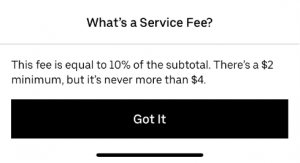
The problem, however, arises when a consumer applies a promotion — including the “Buy One, Get One” and “Free item” promotions — to their order. In such cases, the subtotal displayed at checkout faithfully reflects the price of the cart, after promotions. However, the service fees are still calculated based on the gross price of the cart before promotions. Consumers therefore find themselves paying a service fee on a supposedly free item, in turn also making the service fee higher than the supposed rate of 10% of the displayed subtotal.
*Warning : It is not possible to pinpoint this problem retroactively, by checking your order receipts, since the amount displayed as the subtotal on the receipts does not take into account the applied promotions, unlike the subtotal displayed on the Uber Eats platform.

(screenshot of the subtotal displayed on the Uber Eats platform)
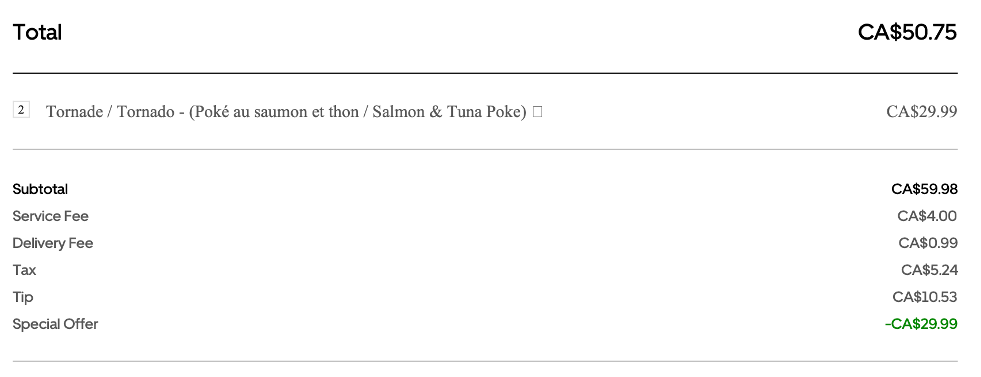
(excerpt of the receipt)
False or misleading representations
As stated by the Consumer Protection Act, “[n]o merchant, manufacturer or advertiser may, by any means whatever, make false or misleading representations to a consumer”.
In assessing whether a representation is false or misleading, the law prescribes that one must take into account the general impression it gives, from the point of view of the credulous and inexperienced consumer. The representation in question is then judged to be false if contrary to reality, or misleading if it is likely to lead to a misunderstanding.
The general impression of the credulous and inexperienced consumer as to the service fees, however, is that they are equal to 10% of the subtotal displayed during checkout, subject to a minimum of $2 and a maximum of $4, when this impression is actually not at all in line with reality.
Failing to mention an important fact
Again, as per the terms of the Consumer Protection Act, “[n]o merchant, manufacturer or advertiser may fail to mention an important fact in any representation made to a consumer”. An important fact can be any determining element of a contract, including the price of the transaction.
Therefore, by failing to specify that the service fees are calculated based on the subtotal of each order before applying any promotion, Uber is clearly failing to mention an important fact pertaining to the contracts made on their platform.
Proposed class
All persons residing in Quebec who have made a transaction on the Uber Eats mobile application or on the www.ubereats.com website and who have paid excess service fees, contrary to the announcement indicating that these fees are equal to 10% of an order’s subtotal, subject to a minimum of $2 and a maximum of $4.
Current state of the case
Awaiting authorization by a Superior court judge.