


On July 12, 2021, our firm filed an application for authorization to bring a class action against the Uber companies. The purpose of this request is to obtain a refund for Quebec consumers who have made a transaction on the Uber Eats website or application and who have paid an excess service fee on their order.
The problem
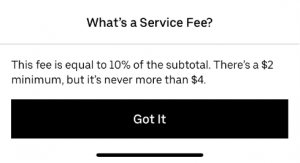
Since mid-April, Uber companies have started charging service fees on orders placed on their platform. This service fee is 10% of the subtotal of each order, subject to a minimum of $2 and a maximum of $4, as explained under tab (i) offered on the Uber Eats app.
The problem targeted by this action arises, however, when a consumer applies an offer, including the “Two for One” and “Free Item(s)” offers, to his order. Indeed, the subtotal displayed at the “Cashier” faithfully reflects the price of the order, taking into account the discount. However, the service fee is still calculated according to the gross price of the basket, without including the offer. The consumer is therefore paying a service fee on a supposedly free item, and therefore, a service fee higher than the anticipated rate of 10% of the advertised subtotal.
*
Warning: It is impossible to see this problem retroactively, by checking your order receipts, since the amount displayed as a subtotal on the receipts does not take into account the applicable offers, unlike the subtotal displayed on the Uber Eats platform.

(screenshot of subtotal displayed at “Cashier”)
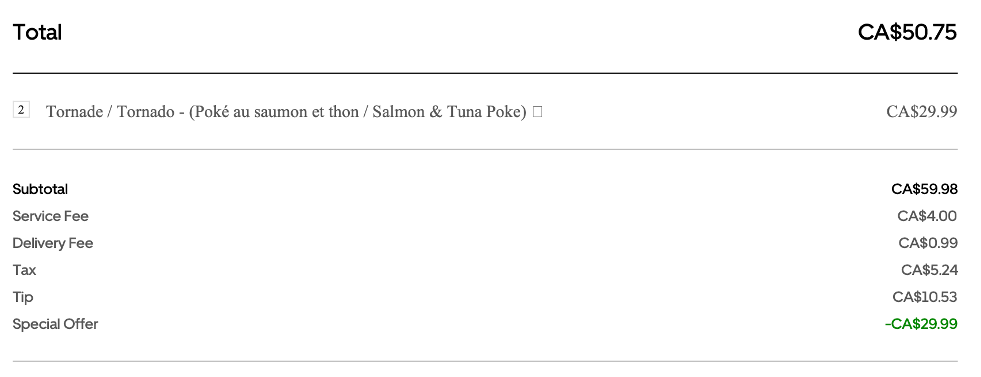
(excerpt from receipt)
False and misleading representations
Under the Consumer Protection Act, “no merchant, manufacturer or advertiser may, by any means whatsoever, make a false or misleading representation to a consumer.”
In assessing whether a representation is false or misleading, applicable law requires that the general impression it gives from the perspective of the gullible and inexperienced consumer must be taken into account. The representation in question is then deemed false if contrary to reality, or misleading if it is likely to lead to an error.
However, the general impression of the gullible and inexperienced consumer about the service fee is that it must represent 10% of the subtotal displayed during the ordering process, subject to a minimum of $2 and a maximum of $4, when this impression is not at all in line with reality.
Ignoring an important fact
Also under the Consumer Protection Act, “[a]ny merchant, manufacturer or advertiser may not, in a representation he makes to a consumer, ignore an important fact.” An important fact can also be any determining element of a contract, including the price of the transaction.
Therefore, by failing to specify that service fees are calculated based on the subtotal of each order, but before applying the offers, the Uber companies are clearly ignoring an important fact to the contracts made on their platform.
Target group
All persons residing in Quebec who have made a transaction on the Uber Eats mobile application or on the website www.ubereats.com and who have overpaid a service fee, contrary to the announcement that this fee is equivalent to 10% of the subtotal of an order, subject to a minimum of $2 and a maximum of $4.
Current status of the file
On December 11, 2024, the Court approved the class action for settlement purposes. To read the judgment, click here.
To read the settlement agreement, click here.
To read the notice to class members, click here.
The settlement agreement hearing took place on December 9, 2024.