


Since the beginning of the COVID-19 pandemic, there has been a significant increase in teleworking. This raises an important question: do homeworkers enjoy the same protection by law in the event of an accident at work?
Although there is no law that specifically governs telework, workers performing their tasks at home are protected by the same laws as other workers. This capsule summarizes recent developments in occupational health and safety law with respect to homework.
What is a workplace accident?
Section 2 of the Act respecting industrial accidents and occupational diseases (AIAOD) provides that an industrial accident is:
an unforeseen and sudden event attributable to any cause, occurring to a person as a result of or in the course of his work and resulting in an employment injury for that person.
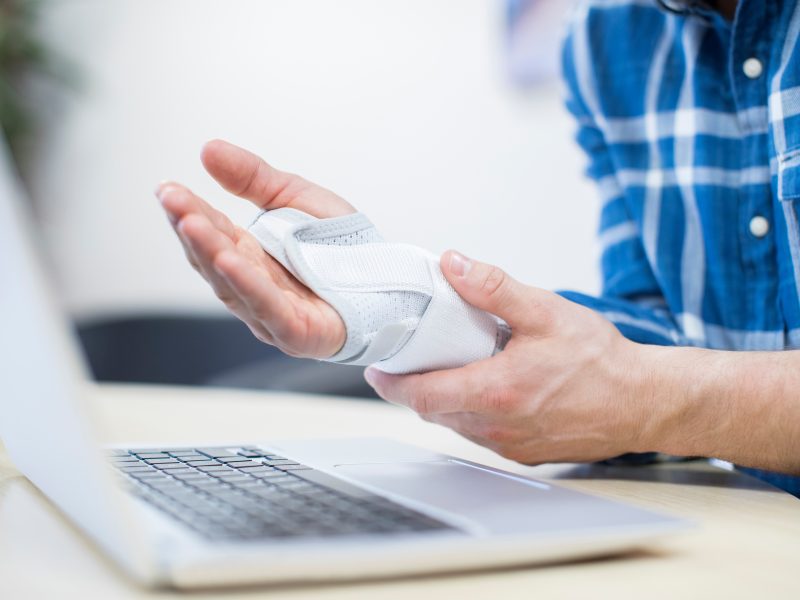
The AIAOD provides a broad definition, which includes all accidents caused by or in the course of work that result in an employment injury. There is no specific requirement or distinction made with working from home that would exclude accidents that occurred in telework mode.
Presumption of employment injury
Under section 28 of the AIAOD, there is a presumption that an injury that occurs at the workplace while the worker is at work is an employment injury. The application of the presumption has the effect of avoiding the worker having to prove the occurrence of an unforeseen and sudden event.
In Club des petits déjeuners du Québec, the Commission des lésions professionnelles, now the Administrative Labour Tribunal, held that the presumption in section 28 applied to teleworkers. The Commission explains that the teleworker’s home must be considered as his place of work. Thus, a worker who sustains an injury while working from home may benefit from the presumption.
Example of an employment injury that occurred in a telework context
In Air Canada and Gentile-Patti, the worker worked as a customer agent and performed her duties from home. While taking her lunch break, she fell down the stairs inside her home. Air Canada argued that this was not a work-related accident under the AIAOD, as the worker was no longer in her professional sphere at the time of the accident.
The Tribunal found that this was an unexpected and sudden event that occurred in the course of work, since breaks are part of the work organization and there was a temporal proximity between the disconnection with the employer and the fall.
Thus, the activity carried out at the time of the accident is part of the professional sphere if it falls within the framework of the employer’s activities, expectations, concerns or objectives.
The decision also recalls that a worker who carries out his employment in teleworking mode enjoys the same protection as a worker who carries it out in the employer’s establishment.
If the CNESST has refused to recognize that you have suffered a workplace accident, do not hesitate to contact us so that we can analyze whether the decision should be contested.
 Simulation